Understanding Endoscopic Discectomy: A Minimally Invasive Solution for Herniated Discs
Introduction
Back pain caused by a herniated disc is one of the most common reasons people seek medical attention worldwide. For many, conservative treatments like physiotherapy, medication, and lifestyle changes provide relief. However, when pain persists, worsens, or starts affecting nerve function, surgical intervention may be necessary.
Traditionally, disc surgery involved large incisions, significant muscle disruption, and long recovery times. Today, endoscopic discectomy has emerged as a modern, minimally invasive alternative that offers effective relief with less trauma to the body. This article provides a detailed, patient-friendly explanation of how endoscopic discectomy works, who it is best suited for, and what recovery looks like.
What Is a Herniated Disc?
The spine is made up of vertebrae separated by soft, cushion-like discs that act as shock absorbers. Each disc has:
A soft inner core (nucleus pulposus) A tough outer layer (annulus fibrosus)
A herniated disc occurs when the inner material pushes through a tear or weakness in the outer layer. This bulge or rupture can press on nearby spinal nerves, leading to pain, numbness, tingling, or weakness—often radiating into the arms or legs.
What Is Endoscopic Discectomy?
Endoscopic discectomy is a minimally invasive surgical procedure used to remove the portion of a herniated disc that is compressing a spinal nerve. It is performed using a thin tube called an endoscope, which contains a camera and specialized surgical instruments.
Unlike open surgery, endoscopic discectomy:
Uses very small incisions (usually less than 1 cm) Causes minimal muscle damage
Is often done under local or light general anesthesia Allows for faster recovery and less postoperative pain
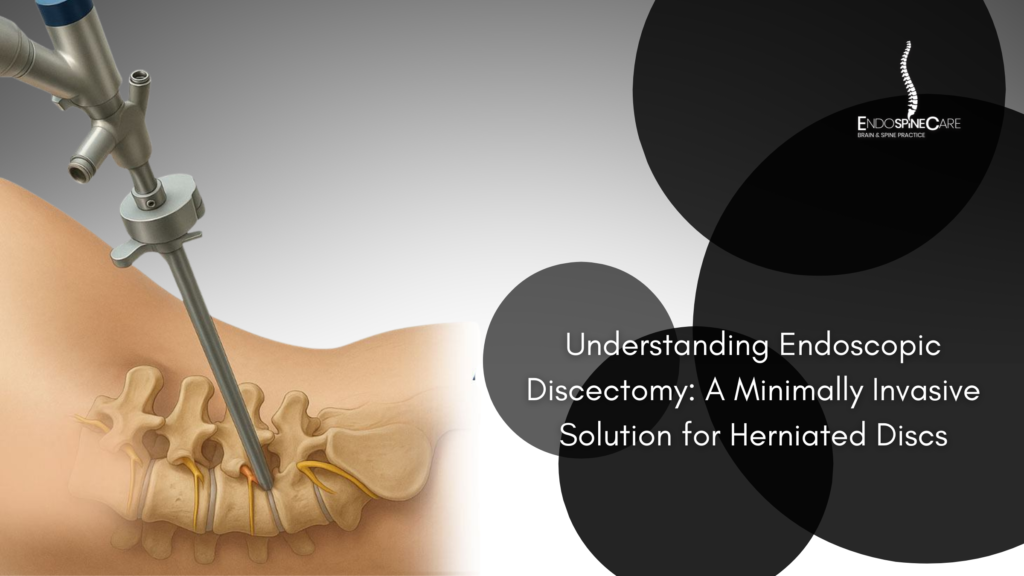
How Endoscopic Discectomy Works (Step-by-Step)
| Step | What Happens |
| Patient positioning | Patient lies face down on a specialized surgical table |
| Anesthesia | Local anesthesia with sedation or general anesthesia |
| Small incision | A tiny incision is made near the affected disc |
| Endoscope insertion | A thin tube with a camera is guided to the disc |
| Disc visualization | High-definition imaging allows precise viewing |
| Disc removal | Only the herniated portion compressing the nerve is removed |
| Closure | No stitches or only one stitch needed |
Because the surgeon works through natural tissue planes rather than cutting muscle, the spine remains more stable and intact.
Types of Endoscopic Discectomy
-
- Transforaminal Endoscopic Discectomy
Accesses the disc through the side of the spine Common for lumbar (lower back) disc herniations
- Transforaminal Endoscopic Discectomy
-
- Interlaminar Endoscopic Discectomy Approaches the disc from the back
Often used when anatomy limits side access
- Interlaminar Endoscopic Discectomy Approaches the disc from the back
The choice depends on disc location, patient anatomy, and surgeon expertise.
Ideal Candidates for Endoscopic Discectomy
Not everyone with back pain needs surgery. Endoscopic discectomy is most suitable for patients who meet specific criteria.
Ideal Candidate Checklist
| Criteria | Yes / No |
| Persistent leg or arm pain for 6–12 weeks |  |
| MRI-confirmed herniated disc | |
| Nerve-related symptoms (numbness, tingling) | |
| Failed conservative treatment | |
| No spinal instability | |
Conditions Commonly Treated
Lumbar disc herniation (sciatica)
Cervical disc herniation (neck and arm pain) Recurrent disc herniation (in select cases)
When Endoscopic Discectomy May NOT Be Suitable
| Condition | Reason |
| Severe spinal instability | Requires fusion surgery |
| Advanced spinal deformity | Needs open correction |
| Large central disc herniations | Limited endoscopic access |
| Infection or tumors | Require different surgical approaches |
A thorough evaluation by a spine specialist is essential before recommending this procedure. Endoscopic Discectomy vs Normal Disc Healing
| Feature | Normal Disc Healing | Endoscopic Discectomy |
| Pain relief | Slow, unpredictable | Often immediate |
| Nerve pressure | May persist | Directly relieved |
| Recovery time | Weeks to months | Days to weeks |
| Risk of recurrence | Moderate | Low with proper care |
Benefits of Endoscopic Discectomy
Minimal tissue damage
Smaller scars
Reduced blood loss
Lower infection risk
Same-day discharge in most cases Faster return to work and daily activities
Many patients report dramatic pain relief shortly after surgery.
Risks and Possible Complications
Although considered very safe, no surgery is entirely risk-free. Potential Risks
| Risk | Frequency |
| Infection | Rare |
| Nerve irritation | Temporary |
| Disc re-herniation | Low |
| Bleeding | Minimal |
| Incomplete pain relief | Uncommon |
Choosing an experienced endoscopic spine surgeon significantly reduces these risks.
Recovery Expectations After Endoscopic Discectomy
Immediate Post-Surgery
Walking within hours
Mild soreness at incision site Significant reduction in nerve pain
First 2 Weeks
Light activities encouraged
Avoid bending, lifting, twisting Pain managed with oral medication
4–6 Weeks
Gradual return to work (desk jobs earlier) Physiotherapy may begin
Improved mobility and stamina
8–12 Weeks
Return to most normal activities
Full recovery for most patients Post-Surgery Symptom Checklist
| Symptom | Normal | Needs Medical Review |
| Mild incision pain | |
 |
| Temporary numbness | |
|
| Increasing leg pain | |
|
| Fever | |
|
| Loss of bladder control | |
|
Long-Term Outcomes
Studies show that endoscopic discectomy offers:
High patient satisfaction
Comparable or better outcomes than open surgery
Lower reoperation rates when combined with proper rehabilitation
Success largely depends on patient compliance with post-operative guidelines and lifestyle modifications.
Conclusion
Endoscopic discectomy represents a major advancement in spine surgery, offering patients a safer, less invasive option for treating herniated discs. With precise nerve decompression, minimal tissue disruption, and rapid recovery, it has become an excellent alternative to traditional open surgery for appropriately selected patients.
If you suffer from persistent nerve-related back or neck pain that has not improved with conservative treatment, consulting a spine specialist about endoscopic discectomy may be the next step toward lasting relief.